
Dakota County Court Records After Arrest
Dakota County court records after arrest are not the same thing as the first jail entry. Booking is the intake step at Dakota County Jail, where the person is processed, photographed, fingerprinted, screened, and listed in current custody if the roster system is available. A court case starts when formal charges are filed. For many local criminal matters, that filing is a criminal complaint from the Dakota County Attorney's Office. The complaint is the formal document that begins a criminal case and states the alleged facts and charges.
The distinction matters. A roster entry may show an arrest, estimated court time, bail, and early charge information. Those entries can be preliminary. The court record tracks what the prosecutor actually filed, what the judge did next, and whether each charge remains pending, was amended, was dismissed, or led to a plea or verdict. Custody and booking details belong with Dakota County jail inmate records; booking photographs are covered with Dakota County jail mugshots. The court record is the charge and case history that follows the arrest.
Dakota County Complaint Search
Dakota County has a useful local court-record path because the County Attorney posts many criminal complaints in a dedicated search tool. The Dakota County criminal complaint search lets users look for complaints by name or date posted. The county states that complaints are available in the tool for 12 months. The same page warns that a charge is not proof of guilt and that a defendant is presumed innocent unless proven guilty.
Not every court record after an arrest appears in that complaint tool. Dakota County excludes complaints involving criminal sexual conduct or child sexual abuse images. Older complaints, restricted filings, and cases outside the posting window may require Court Administration, a public access terminal, or Minnesota Court Records Online. For a recent jail arrest, the complaint search is still a strong first stop because it focuses on the charging paper itself, not just the custody record.
The official Dakota County complaint page shows the criminal complaint search fields in this layout:
| Field | Type | Required | Notes |
|---|---|---|---|
| Last name | Text | At least one criterion | Use the defendant's last name; the page code allows up to 50 characters. |
| First name | Text | No | Add a first name to narrow common results. |
| From date posted | Date picker | No | Limits results to complaints posted after a chosen date. |
| Thru date posted | Date picker | No | Sets the end of the posting-date range. |
| Search | Submit | N/A | The page displays a searching message while results load. |
The Dakota County Attorney complaint page is shown in the captured source image below.
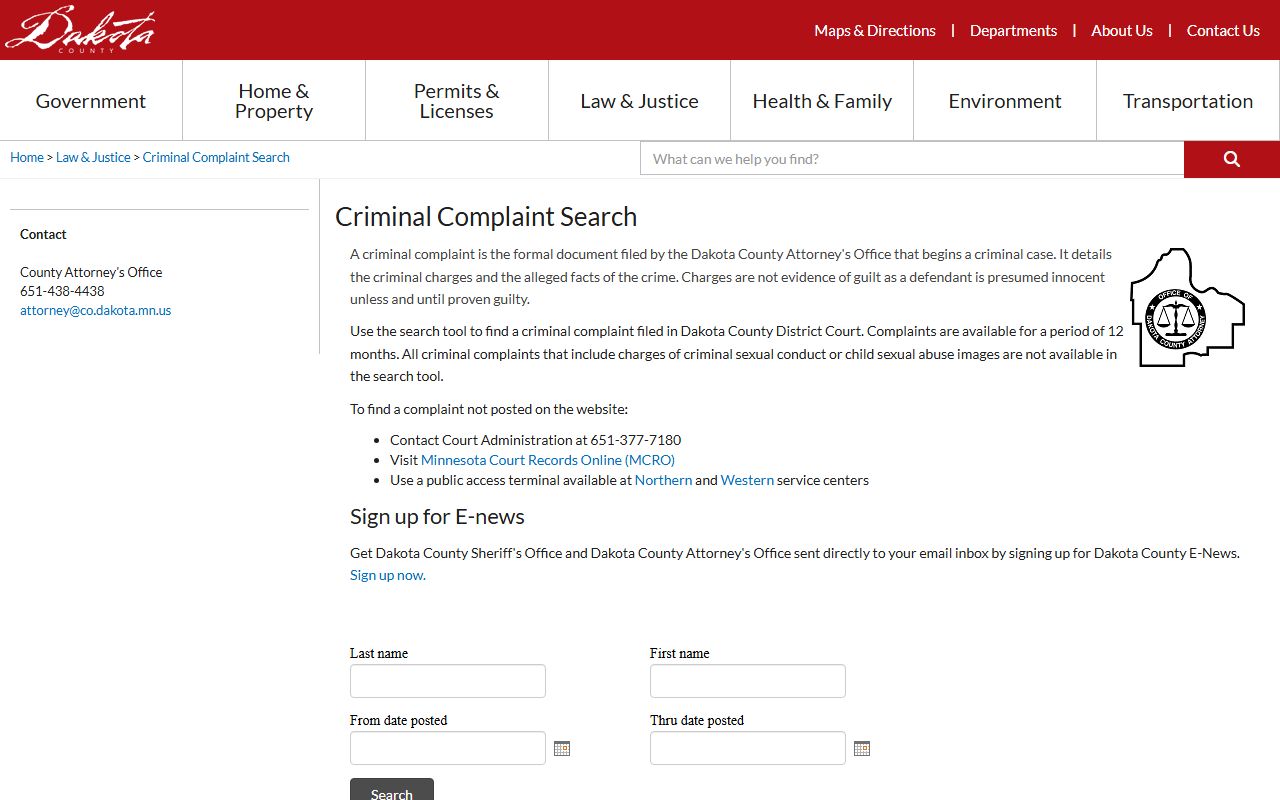
The search fields match the research record: name fields plus a posted-date range for complaints that remain inside the county's online window.
MCRO Case Records After Arrest
Minnesota Court Records Online, often called MCRO, is the statewide court search channel for Dakota County District Court case records. The Minnesota Judicial Branch MCRO page describes four main search tabs: Case Search, Document Search, Hearing Search, and Judgment Search. For a Dakota County court record after a jail arrest, Case Search can locate the criminal case, the register of actions, and public documents when remote access is allowed.
MCRO has limits that are important in pending criminal cases. The research notes that pending criminal, traffic, and petty misdemeanor cases without conviction may not return by defendant name, although they can return by case number. Some older or restricted documents are not available remotely. Public access terminals at Dakota County court locations may show material that remote access does not. If a complaint was posted locally, the complaint number or case details can help when searching MCRO.
| MCRO Tab | Search Methods | Use After Jail Arrest |
|---|---|---|
| Case Search | Person, business, attorney, case number, citation, attorney bar number | Find the criminal case and public register of actions. |
| Document Search | Case number | Look for public complaint, order, and filing documents if remotely available. |
| Hearing Search | Person, business, case number, judicial officer, attorney, bar number | Check first appearance, omnibus, pretrial, plea, or sentencing settings. |
| Judgment Search | Debtor name | Useful for civil judgments, not the usual first criminal-arrest search. |
The Minnesota Court Records Online overview appears in the source image used for the statewide court-search context.
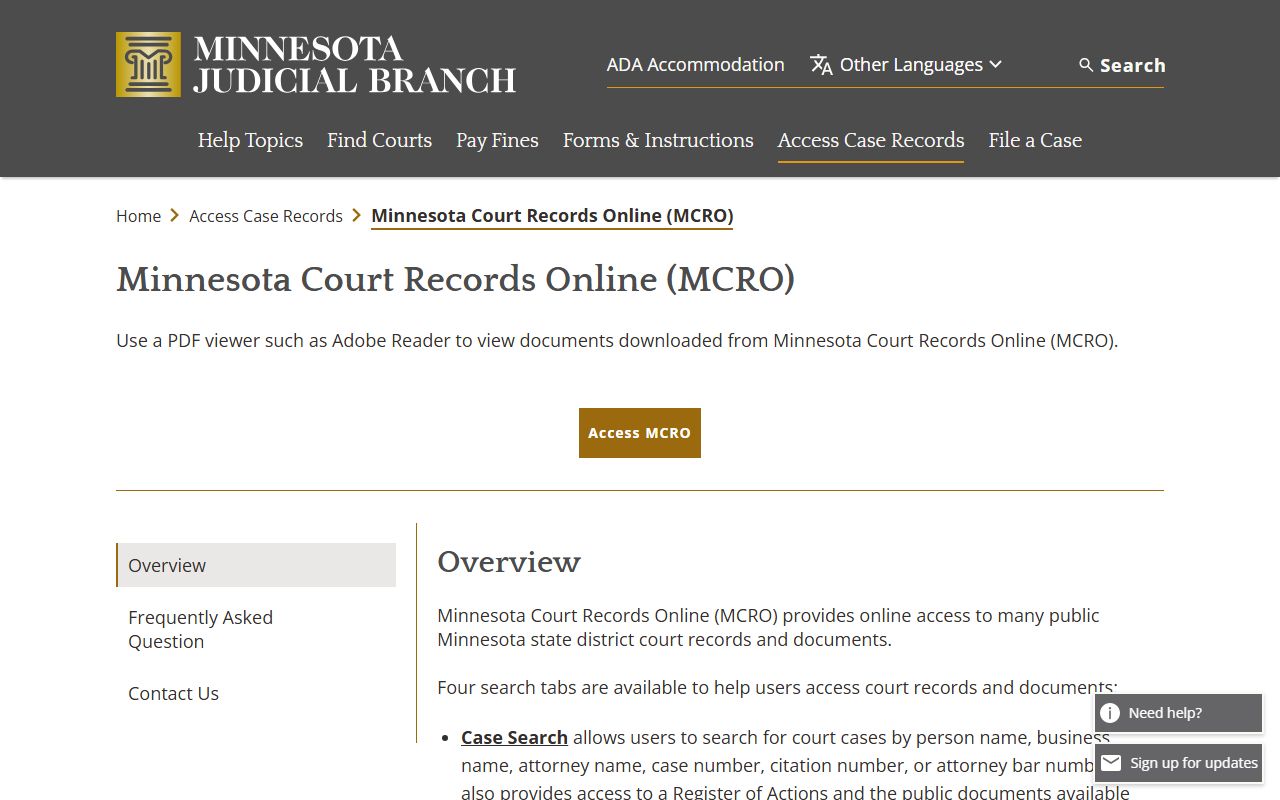
MCRO is broader than the county complaint tool, but the remote-access restrictions make the two systems complementary rather than interchangeable.
Dakota County Arrest Charge Documents
The charging document is the bridge between a jail arrest and a court record. In Dakota County, the research identifies the criminal complaint as the key local filing from the County Attorney's Office. Minnesota criminal cases can also involve other charging forms, depending on procedure and case type. The practical point is simple: a person can be booked into Dakota County Jail before the final court charge list is clear.
| Document | Who Files It | What It Does | Dakota County Use |
|---|---|---|---|
| Complaint | County Attorney or charging prosecutor | Begins many criminal cases and states alleged facts and charges. | The local complaint search is built around this document. |
| Information | Prosecutor | Formal charge document used in some criminal matters after the case is underway. | Check MCRO and court files when the complaint tool does not show the full case history. |
| Indictment | Grand jury | Formal accusation in serious cases reviewed through grand-jury procedure. | Less common for routine jail-arrest searches; public access may depend on case status and court rules. |
Charge documents should be read as allegations unless a court disposition says otherwise. Dakota County's complaint page makes that point directly. The charge text may describe the law alleged to have been violated, but it does not decide guilt.
Dakota County Charge Status Records
Charge status can change after a Dakota County jail arrest. A roster may show the arresting charge or an early booking label. The prosecutor may file a different count, add a count, amend a count, or decline a charge. Court minutes and the register of actions then show hearings and disposition events. A reader should compare the complaint, the MCRO case history, and the current jail record when custody is still active.
| Status | Plain Meaning | Record Check |
|---|---|---|
| Pending | The charge is still open and has not reached final disposition. | Use MCRO hearing and case searches for next court dates. |
| Amended | The prosecutor changed the count, level, statute, or wording. | Compare the original complaint with later docket entries. |
| Reduced | The charge level or count was lowered, often through plea talks or later review. | Check the final disposition, not just the first booking entry. |
| Dismissed | The court record shows the charge was dropped or dismissed. | Review whether other counts remain active. |
| Convicted | A guilty plea, verdict, or finding resolved the charge against the defendant. | Use the disposition and sentencing entries as the controlling court record. |
Note: A charge can be public before guilt is proven, so the disposition line matters more than the arrest label.
Dakota County Court Locations
Dakota County criminal cases are filed in Dakota County District Court, First Judicial District. The main criminal court location is the Dakota County Courthouse and Judicial Center in Hastings. The Minnesota Judicial Branch also lists the Western Service Center in Apple Valley and the Northern Service Center in West St. Paul for court services and public access terminals. All three locations are listed with 8 a.m. to 4:30 p.m. weekday hours in the research.
Dakota County District Court
Judicial Center
1560 W. Highway 55
Hastings, MN 55033
651-377-7180
Western Service Center
14955 Galaxie Ave. West
Apple Valley, MN 55124
Northern Service Center
1 West Mendota Rd., Ste. 140
West St. Paul, MN 55118
The Minnesota Judicial Branch Dakota County court page shows the court locations and public service details used for court-record access.
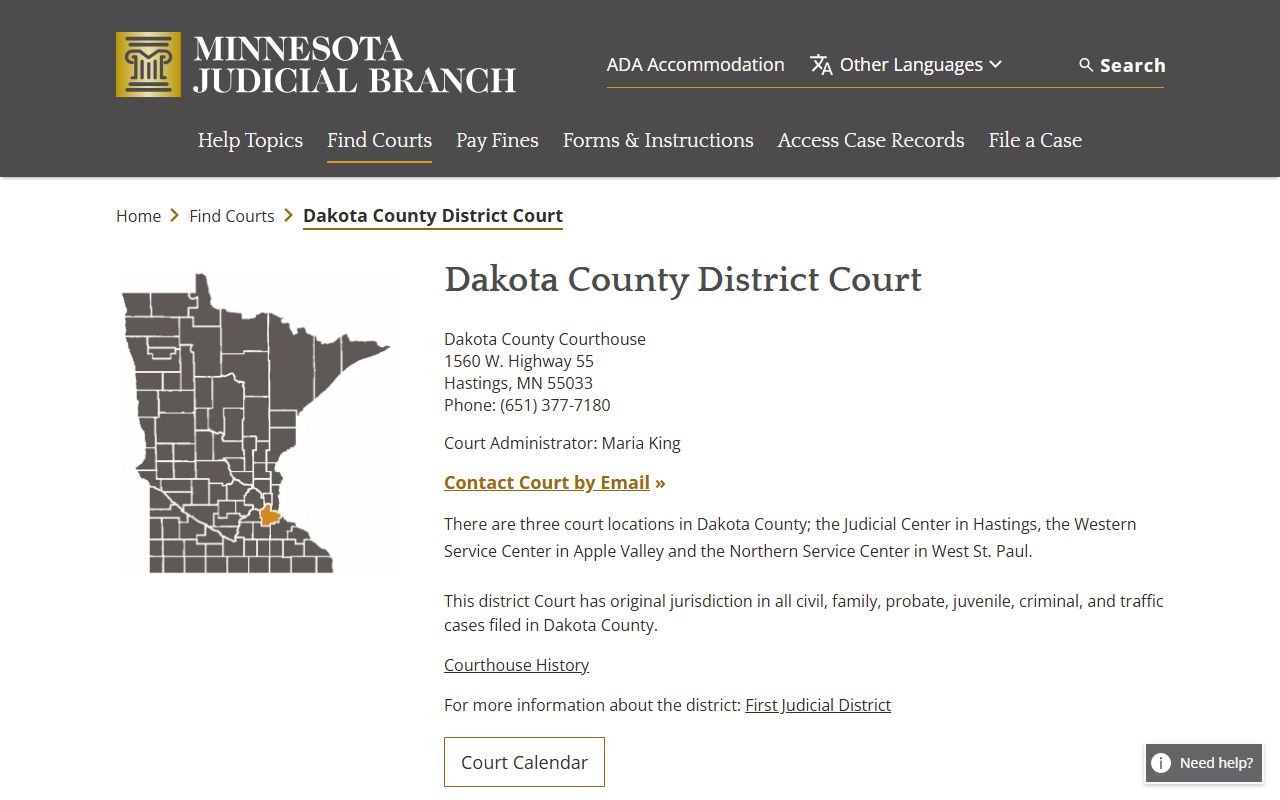
Public terminals at the service centers can matter when MCRO does not provide remote access to a pending or restricted criminal filing.
Dakota County Bail and Warrants
Bail and warrants often explain why a person remains in custody after the court record opens. Dakota County's jail bail page says most inmates may post cash bail or a bond. For Dakota County charges, cash bail is accepted at District Court in Hastings during weekday business hours. After 4:30 p.m., on weekends, and on holidays, Dakota County charges can be paid at the jail lobby, cash only and in the exact amount. Lobby kiosks at the Law Enforcement Center are available 24 hours a day for cash bail or bond.
Warrants have their own search and surrender routes. Dakota County identifies criminal arrest warrants, civil warrants, bench warrants, complaint warrants, and probation or parole violation warrants. A warrant with a bail or bond option can sometimes be cleared at a District Court Administration window without the person being booked into jail. Body-only or no-bail warrants require arrest and court review. Probation or parole holds may also prevent immediate release even when a new Dakota County charge has bail.
| Route | Where to Check | Effect on Court Records After Arrest |
|---|---|---|
| Cash bail | District Court during business hours or jail lobby after hours | May allow release while the case remains pending. |
| Bonding-agent bond | Bonding agent and court or jail posting channel | Secures release under court-set conditions. |
| Complaint warrant | Dakota County warrant search and court records | Can link an arrest directly to a newly charged complaint. |
| Body-only hold | Court or jail staff | Requires custody until court review sets next steps. |
| Probation or parole hold | Community Corrections or MNDOC process | May keep the person in jail apart from new-charge bail. |
For warrant data, the Dakota County warrant search requires a last name and warns law enforcement not to arrest based only on website data without NCIC confirmation. Public users with warrant tips are directed to 651-438-TIPS.
Dakota County Charge vs Conviction
A Dakota County arrest, a filed charge, and a conviction are three different record points. The arrest is the law-enforcement event. The charge is the allegation filed in court. A conviction is the final result only if a guilty plea, verdict, or qualifying finding occurs. Dakota County's complaint page expressly warns that complaints are not evidence of guilt.
| Record Point | What It Means | Where It Appears |
|---|---|---|
| Arrest | A person was taken into custody or booked. | Jail roster, arrest data, warrant records, and law-enforcement data. |
| Charge | A prosecutor filed an accusation in court. | Complaint search, MCRO, and District Court records. |
| Conviction | The court record shows guilt by plea, verdict, or finding. | Disposition and sentencing entries in the court record. |
Dakota County Sealed Court Records
Minnesota public-access law starts with a broad rule. Minn. Stat. 13.03 says government data are public unless classified otherwise. Law-enforcement data are addressed in Minn. Stat. 13.82, while corrections and detention data are covered in Minn. Stat. 13.85. Court records can also be limited by court rule, case type, document type, or expungement order.
Expungement is the records-clearing route after some dismissals, acquittals, eligible convictions, and other qualifying outcomes. Minnesota has automatic expungement under Minn. Stat. 609A.015 for eligible criminal or delinquency records, and petition-based expungement under Minn. Stat. 609A.02. Expungement usually means the record is sealed from public view. It does not prove that all copies, screenshots, or third-party reposts vanish.
| Access Status | What Changes | What May Remain |
|---|---|---|
| Public | Available through court, complaint, jail, or data-practices channels if not restricted. | Accuracy still must be checked against the source office. |
| Sealed | Hidden from public access by law, rule, or court order. | Limited agency or court access may continue. |
| Expunged | Public access is sealed for eligible records under Chapter 609A. | Relief depends on the exact order or automatic-expungement category. |
| Not remotely accessible | May not display through MCRO from a public internet search. | Public terminal access or Court Administration may still be needed. |
Access limit: Juvenile matters, sealed records, restricted complaint categories, and some pending criminal cases may not be visible through the public online tools.
Dakota County Attorney Records
The Dakota County Attorney is Kathryn M. Keena. The office is the local prosecutor for county-level crimes and files criminal complaints in Dakota County District Court. The office contact listed in the research is 651-438-4438, with attorney@co.dakota.mn.us as the general email and 1560 Highway 55, Hastings, MN 55033-2343 as the office address in the county data-practices materials.
The County Attorney also provides victim and witness support. That role is separate from the jail roster and separate from MCRO. Victim support helps people navigate the criminal justice process, while the complaint search and court records show public filings and case events. For copies of records not available online, Dakota County's data-practices process and Court Administration are the more direct access routes.
Note: For District Court time questions tied to a custody entry, Dakota County's jail search page points users to District Court at 651-377-7188.